“Public education is the foundation of the prosperity of the nation………..”
Antonio Garcia Cubas (1893)
Very rightly said but recent policy makers are dividing public into class and their emphasis seems to be tilted towards a specific class of people.
Here I am talking about the higher education where there are few disciplines which are ready to flourish and had showed their acceptance to society but only a bit have been done for their disciples’ sake. "The jack of all traits and master of nothing" is a widely known phrase in Indian Geographical Academic lanes. It is argued that as geography demands to study socio-cultural environment over the physical landscape, it ask to study socio-cultural elements (touches the fields of sociology, demography, economics, regional development etc.) and physical elements (under lithosphere, hydrosphere and atmosphere) as well, so they are not able to focus on either which is not true when it comes to higher research where one need to focus on issue. Scholars of the discipline linked with social sciences and natural sciences both at a time. But when it comes to higher and specific researches they have been restricted to a limited area. The restriction is not due to the subject matter but because of lack of infrastructure and partial behavior of administration towards the humanities and social sciences.
Infrastructure and Govt. Policies
The recent government policy towards educational infrastructure in not sufficient enough and Humanities and Social Sciences Institutes (HSIs) are worst affected. Human Resource and Development Minister has announced a 100 day Agenda which as stir fundamental educational system by introducing new policies in development of educational system and increasing scholarships. Even the scholarships are lean towards the Science and Technology Institutes (STIs). The scholarships of STIs have been increased from Rs. 7,000 per month to Rs. 12,000 per month plus 25,000 of contingency but the scholarship of HSIs especially of geography are still waiting at Rs. 5,000 per month with 10,000 of contingency. Despite the fact that Humanities and Social Science students are spreading awareness which is accumulated in scientific streets and scientific facts to the society are neglected.
UGC’s Axe
It has been a trend now-a-days that socio-economic studies do not receive its much awaited status and value in society. It is often argued that the researches are cooked and do not have its relevance. It is true to some extent but the critics rather should get know why some scholars come out with cooked researches after their five to seven year of devotion. It is because of HSIs scholars do not find future assurance in research work as he or she will not be allowed to pursue academic carrier due to the compulsion of National Eligibility Test (NET). The irony of the system is that a scholar whether focus on the research he will not been able to crack the Test and if he or she focus on the Test (NET) the quality of research will degrade as both require its special attention and approach to study. According to a recent notification of UGC, Ph.D holding candidates will not be allowed to pursue their carrier in academics until they have clear National Eligibility Test (NET). Against which All-India Researchers Coordination Committee organized a protest march in the Capital.
It is not the mere reason of stir in various section of academic however 100 day Agenda proposed by Prof. Yash pal was also criticized in the different segments of intellectuals.
Rejuvenation and Brain-drain
Geography as a discipline is very ancient and throughout proved its relevance in the contemporary arena. It is a multi-disciplinary science which submerged contemporaries of every time in it.
IN 1960s it has included quantitative methods to make the discipline more scientific and empirical in nature. Though it also sparks some counter disciplines (Behaviorism, Positivism, Radicalism etc.)
During 1980s Remote Sensing and GIS give it a boost which is still on the go and booming with the time passing.
A new trend has been seen in the 21st century among the IAS aspirants in opting geography as an optional subject which suggests that government know the importance of the discipline.
Despite the entire fact no special attention has been paid by central and state governments to flourish it (geography as a discipline) rather it is being neglected. These phenomena forcing geographers to change their discipline and those who have walked too far are looking towards abroad to achieve something from the discipline and that causing brain-drain of great potential.
Friday, August 21, 2009


Tuesday, December 2, 2008
Workplace Pollution - NOISE
 The list of typical sounds in an office – phones ringing incessantly, mobile phones with jarring ring tones, people blabbing on their phones, loud conversation with one another, gossip sessions band in the middle of office, loud groans, sighs etc. from office mates. It must be a difficult work amidst this entire racket and fact is workplace noise can be distracting and affect productivity. Noise becomes a major source of distraction especially in today’s workplaces that are designed on an open concept or are basically cubicles where employees work in close proximity with only thin walls separating them. An open office design creates distractions, offers less privacy and definitely more noise. The lack o privacy allows everyone to listen to what everyone else is saying. The thin barriers allow even the smallest sounds to be carried across the room and other noise sources only add to the din.
Research studies have found out that nearly 80 percent of employees complain of being unable to work due to noise distraction. Conventional distractions hamper productivity. High noise levels increase stress levels: makes employees expend lesser efforts in solving difficult problems, decrease focus and can even increase errors. Distraction noise levels can also hamper creativity.


Studies show that people pay more attention to intelligible noise, which includes conversation, than to unintelligible sounds. When conversations are taking place all around, a person’s brain tries to process the conversation even though this may not be conscious effort. During such an effort, tasks involving creativity like writing, designing problem solving or even putting together a proposal gets affected. So if employees have to use creativity in their work, the company must ensure that noise level are kept to a minimum.
Some may argue that people need to talk, discuss and brainstorm at work to achieve better results, but the issue here is the noise levels they generate and not the actual process of interaction. Even in workplaces, which require little interaction, colleagues being hard on the keyboard or carrying loud conversations on their mobiles can disturb others. The fact that noise levels can act as a serious distraction is not acknowledge by many organizations. Employees too accept this as a necessary workplace hazard they have to live with. But it time the issue is taken seriously.
One way is for human resources to have a strong policy against loud conversations and chatting in cubicles. Such a policy should be part of the rules in the employee handbook and also be part of the orientation of new employees. Such rules when suddenly enforced on employee will be harsh disciplining. But if such rules are part of the corporate culture, employees will accept it more easily and adhere to it. Rules must be made against playing music on computer speakers and employees must be advised to use headphones. They should be told to head outside to the lobby or corridor to carry out any personal conversation on their cell phones. It should be insisted that mobile phones be kept on silent mode.
In spite of these rules if some employees continue to make a lot of noise, employees can take up the matter with their manager who in turn can talk to the immediate boss of those employees. Direct confrontation is best avoided. If co-worker are a source of disturbance and interrupt work, then the affected employee should be frank and tell them about a better time to talk. If noise levels still continue to distract, then the employee can use options like noise-cancelling headphones.
Change in the office design like erecting sound absorbent walls or making higher cubicle partitions can reduce noise levels. Huddle rooms or cafeteria can be built in the corners of floors where people can meet and talk. Another effective way is to install sound masking systems. These work on the principle that when some background noise (the sound of a an or air-conditioner or even ‘white noise’) is added to the environment it reduces the attention paid to the existing noise and they will become less distraction. Besides it ensures that private conversations can be carried out without the risk or others overhearing them.

Studies have found that sound masking systems can effectively increase the focus and concentration of worker and can reduce distractions, error rates and stress in employees. Noise continues to be a major source of workplace distraction and both the management and employees must make a conscious effort to reduce sound levels to make the workplace more productive.
Thursday, June 12, 2008
REGIONAL IMBALANCE AND REGIONAL PLANNING
REGIONAL IMBALANCE AND REGIONAL PLANNING
(During five year plans)
India is a diversified country. People are diversified on the basis of culture, language, standard of living, urbanization growth etc. since India get independence at 15th august 1947, various acts, programs and plans are made and implemented, state and national level respectively. Finance commission and planning commission were two higher level authorities who were responsible for the overall development of India as a one nation. During the first two five year plan period (1951-52 to 1961-62) sectoral planning was the main aim of development that sown the first seed of regional imbalance by developing one regional agricultural independent and other region lagged behind.
During the 4th and to 6th plan period when planner realized the value of regional planning, various programs and policies were announced for the sake of all around development. Indian government has implemented various policies in industrial sector for rural development.
1. Decentralization of industries.
2. Investment subsidies in economically backward regions.
3. Transportation subsidies.
4. MRTP and FERA restrictions were implemented to promote land scale industries in the rural sector.
5. Development of SEZs.
6. Development of Growth Poles.
Besides all this steps which is been taken for the decentralization of the industries to curb out regional imbalance, there were some specific problem based programs that were put into operation during 4th plan period and further modified and implemented in the next plan period. Among those, major 10 programs are;
1. Drought Prone Area Program (DPAP)
2. Command Area Program (CADP)
3. Small Farmer Development Agency (SFDA)
4. Crash Scheme for Rural Development (CSRE)
5. Plot Intensive Rural Employment Program (PIREP)
6. Special Hill Area Program
7. Integrated Tribal Development Program (ITDP)
8. National Rural Employment Program (NREP)
9. Rural Landless Employment Guarantee Program (RLEGP)
10. Jawahar Rozgar Yojna (JRY), this program is the outcome of the submerg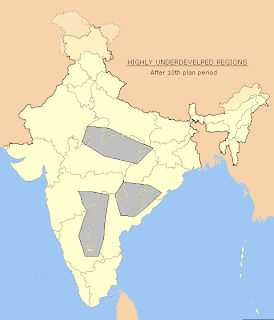 ence of NREP and RLEGP.
With the help of above program shape of the India has been slightly changed. Now the area under regional imbalanced is negligible.
Presently there are various project in the pipeline to remove every aspect of regional imbalance viz..
1. National Rural Employment Guarantee Act (NREGA)
2. Prime Minister Sadak Nirman Yojna
3. Public Distribution System (PDS)
(During five year plans)
India is a diversified country. People are diversified on the basis of culture, language, standard of living, urbanization growth etc. since India get independence at 15th august 1947, various acts, programs and plans are made and implemented, state and national level respectively. Finance commission and planning commission were two higher level authorities who were responsible for the overall development of India as a one nation. During the first two five year plan period (1951-52 to 1961-62) sectoral planning was the main aim of development that sown the first seed of regional imbalance by developing one regional agricultural independent and other region lagged behind.
During the 4th and to 6th plan period when planner realized the value of regional planning, various programs and policies were announced for the sake of all around development. Indian government has implemented various policies in industrial sector for rural development.
1. Decentralization of industries.
2. Investment subsidies in economically backward regions.
3. Transportation subsidies.
4. MRTP and FERA restrictions were implemented to promote land scale industries in the rural sector.
5. Development of SEZs.
6. Development of Growth Poles.
Besides all this steps which is been taken for the decentralization of the industries to curb out regional imbalance, there were some specific problem based programs that were put into operation during 4th plan period and further modified and implemented in the next plan period. Among those, major 10 programs are;
1. Drought Prone Area Program (DPAP)
2. Command Area Program (CADP)
3. Small Farmer Development Agency (SFDA)
4. Crash Scheme for Rural Development (CSRE)
5. Plot Intensive Rural Employment Program (PIREP)
6. Special Hill Area Program
7. Integrated Tribal Development Program (ITDP)
8. National Rural Employment Program (NREP)
9. Rural Landless Employment Guarantee Program (RLEGP)
10. Jawahar Rozgar Yojna (JRY), this program is the outcome of the submerg
 ence of NREP and RLEGP.
With the help of above program shape of the India has been slightly changed. Now the area under regional imbalanced is negligible.
Presently there are various project in the pipeline to remove every aspect of regional imbalance viz..
1. National Rural Employment Guarantee Act (NREGA)
2. Prime Minister Sadak Nirman Yojna
3. Public Distribution System (PDS)
Subscribe to:
Posts (Atom)

.jpg)